

Role of Knives in Outdoor Survival: Practical Uses and Impact
Most American outdoor enthusiasts face situations where having the right survival knife can make a real difference. When wilderness conditions turn unpredictable, a single tool often becomes a lifeline for cooking, building shelter, and protection. With over 40 million Americans venturing outdoors each year, choosing a high-quality Damascus steel knife becomes crucial for those who value durability, versatility, and fine craftsmanship. This guide highlights the essential roles, types, legal considerations, and proper maintenance practices every American survivalist should know.
Table of Contents
- Defining The Role Of Survival Knives
- Types Of Outdoor Survival Knives
- Essential Functions And Real-World Uses
- Legal Regulations For Knife Carry And Use
- Safety, Maintenance, And Common Mistakes
Key Takeaways
| Point | Details |
|---|---|
| Survival Knife Importance | Survival knives are essential tools for various critical activities in wilderness settings. |
| Types of Survival Knives | Common categories include fixed blade, folding, tactical, bushcraft, and boot knives. |
| Legal Regulations | Knife laws vary greatly by state and locality, so it’s crucial to understand local regulations before carrying. |
| Maintenance and Safety | Regular cleaning, sharpening, and proper storage are vital for maintaining a survival knife’s effectiveness and safety. |
Defining the Role of Survival Knives
Survival knives are specialized tools designed to meet the extreme challenges of wilderness environments, serving as critical lifelines when traditional equipment fails. Unlike standard cutting implements, these robust instruments are engineered to perform multiple essential functions during emergency scenarios. Survival knives historically evolved from hunting and butcher knife designs, incorporating specialized features that dramatically increase a user’s ability to navigate and survive challenging outdoor conditions.
The fundamental purpose of a survival knife extends far beyond simple cutting tasks. These versatile tools are engineered to support critical survival activities such as building shelter, preparing food, creating fire, crafting hunting tools, and providing personal protection. Military personnel and outdoor enthusiasts rely on survival knives with specific design characteristics like full tang construction, which ensures the blade extends through the entire handle, providing maximum strength and durability under extreme stress.
A comprehensive survival knife typically includes several strategic design elements that distinguish it from conventional cutting tools. These features often include a fixed blade for maximum reliability, a robust handle with potential storage capabilities, a blade thick enough to withstand heavy chopping and prying, and a shape conducive to multiple wilderness tasks. Modern survival knives are meticulously crafted to balance lightweight portability with exceptional functional performance, making them indispensable companions in unpredictable outdoor environments.
Pro Tip: Always maintain your survival knife with regular cleaning, sharpening, and careful storage to ensure its reliability during critical moments in wilderness settings.
Types of Outdoor Survival Knives
Survival knives represent a critical category of outdoor tools with diverse designs tailored to specific wilderness challenges. Survival knives are primarily categorized by blade type and deployment mechanism, each offering unique advantages for different environmental scenarios. The primary classifications include fixed blade, folding, assisted opening, and specialized tactical knives, each engineered to address specific survival requirements.
Fixed blade knives represent the most robust survival knife category, characterized by their full tang construction and unparalleled strength. These knives provide maximum durability for heavy-duty tasks like chopping wood, building shelters, and processing game. In contrast, folding knives offer superior portability and compact storage, making them ideal for backpackers and hikers who prioritize weight reduction. Tactical survival knives often feature additional functionalities like integrated fire starters, glass breakers, and multipurpose handle designs that extend their utility beyond traditional cutting tasks.
Beyond basic design categories, survival knives can be further distinguished by their specialized purposes. Bushcraft knives focus on precise woodworking and wilderness craft techniques, while boot knives provide discreet, lightweight options for personal defense and emergency scenarios. Tactical survival knives typically incorporate high-performance materials like advanced stainless steel and ergonomic handle designs that enhance grip and control in challenging outdoor environments. Modern survival knife design represents a sophisticated balance between functional performance, weight considerations, and adaptability to diverse wilderness challenges.
Here is a comparison of common survival knife types and their best-use scenarios:
| Knife Type | Strengths | Typical Users |
|---|---|---|
| Fixed Blade | Maximum durability, full tang | Campers, hunters, military |
| Folding Knife | Compact, easy to carry | Hikers, urban users |
| Tactical Knife | Added functions (e.g., firestarter) | Search & rescue, law enforcement |
| Bushcraft Knife | Precision for woodworking | Bushcrafters, scouts |
| Boot Knife | Discreet, lightweight defense | Emergency responders, outdoorsmen |
Pro Tip: Select a survival knife that matches your specific wilderness environment and anticipated survival needs, considering factors like blade length, material, and intended primary usage.
Essential Functions and Real-World Uses
Survival knives represent far more than simple cutting tools, serving as versatile lifelines in challenging wilderness environments. Survival knives play a critical role in outdoor emergency scenarios, enabling users to perform a wide range of essential survival tasks. Their multifunctional design allows outdoor enthusiasts to address fundamental survival needs including shelter construction, food preparation, tool crafting, and personal protection.
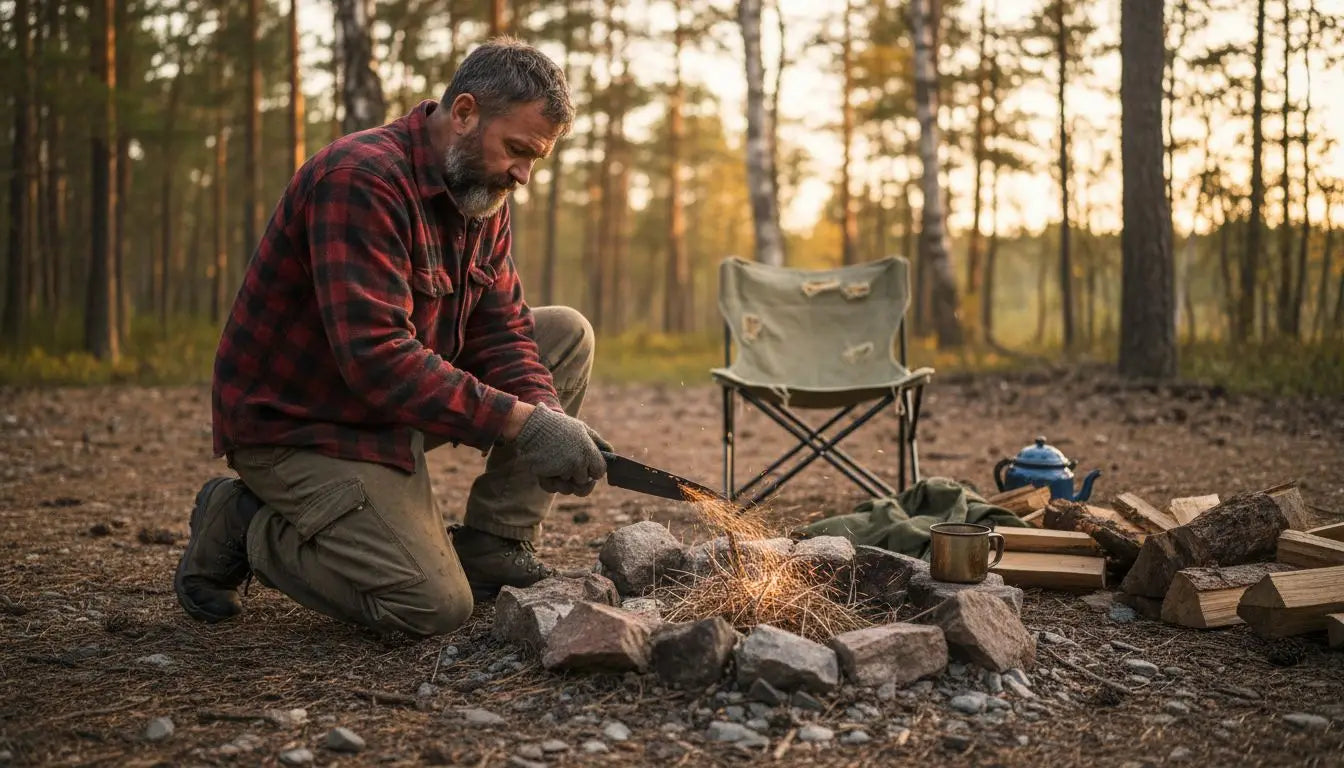
In wilderness settings, survival knives become indispensable for addressing critical survival challenges. These tools excel at wood processing, enabling users to chop timber for shelter building, create kindling for fire starting, and craft improvised tools and implements. Game processing becomes significantly easier with a high-quality survival knife, allowing hunters and wilderness travelers to efficiently dress and prepare game meat. Additionally, survival knives can be used for emergency first aid, cutting medical bandages, creating makeshift splints, and removing clothing to treat injuries in remote locations.
Beyond traditional wilderness applications, survival knives demonstrate remarkable versatility across different environments and scenarios. Military personnel rely on these tools for equipment repair, emergency extraction, and situational problem solving. Search and rescue teams utilize survival knives for cutting safety harnesses, creating emergency shelters, and managing unexpected terrain challenges. The knife’s utility extends to urban survival scenarios, where its robust design can help manage unexpected mechanical failures, create emergency repairs, and provide personal protection in unpredictable situations.
Pro Tip: Practice basic knife skills and survival techniques before venturing into wilderness environments to maximize your survival knife’s potential and ensure you can effectively use it under stress.
Legal Regulations for Knife Carry and Use
Navigating knife ownership involves understanding a complex landscape of legal regulations that vary dramatically across different jurisdictions. Knife carry laws in the United States demonstrate significant state-by-state variations, requiring owners to be meticulously informed about local restrictions. These regulations typically address blade length, knife type, carry method, and specific location restrictions, making comprehensive knowledge essential for responsible knife ownership.
Most state regulations focus on several key parameters that determine legal knife possession. Folding knives generally face fewer restrictions, with most jurisdictions allowing blades under 3 inches for everyday carry. Fixed-blade and automatic knives encounter more stringent regulations, often being prohibited in public spaces, government buildings, schools, and airports. Urban areas tend to have more restrictive policies compared to rural regions, with specific rules about concealed versus open carry that can result in significant legal consequences for uninformed carriers.
The complexity of knife laws extends beyond simple state-level restrictions. Local municipalities may implement additional regulations that further complicate legal knife possession. Hunters, outdoor enthusiasts, and professional workers using knives as tools must pay particular attention to nuanced legal distinctions. Some states provide specific exemptions for occupational use, hunting, fishing, and recreational activities, creating a patchwork of regulations that requires careful navigation. Understanding these legal intricacies is crucial for avoiding unintentional legal violations and ensuring responsible knife ownership.
Pro Tip: Always research current local knife laws before traveling or purchasing a new knife, as regulations can change and vary significantly between jurisdictions.
Safety, Maintenance, and Common Mistakes
Maintaining a survival knife requires systematic attention to safety protocols and proactive maintenance strategies. Safety education remains critical for responsible knife ownership, with proper handling techniques preventing potential accidents and preserving equipment integrity. Understanding fundamental safety principles involves recognizing the knife as a precision tool that demands respect, careful handling, and consistent maintenance.
Common maintenance mistakes often stem from neglecting routine care and improper storage practices. Fixed-blade and folding knives require different maintenance approaches, with folding mechanisms demanding periodic lubrication and pivot point inspection. Critical maintenance steps include regular cleaning to prevent rust and corrosion, systematic blade sharpening to maintain cutting performance, and careful inspection of handle integrity and blade alignment. Storing knives in protective sheaths, avoiding extreme temperature environments, and keeping blades dry are fundamental practices that significantly extend a knife’s operational lifespan.
The table below highlights common survival knife maintenance errors and their potential risks:
| Maintenance Mistake | Risk to Owner | Knife Impact |
|---|---|---|
| Failing to clean regularly | Rust or corrosion | Deterioration of blade |
| Not sharpening routinely | Reduced cutting power | Increased effort needed |
| Improper storage | Blade dulling, damage | Shortened lifespan |
| Ignoring moving parts | Malfunctions, jamming | Handle/blade failure |
Safety practices extend beyond physical maintenance, encompassing user technique and environmental awareness. Proper cutting techniques involve always moving the blade away from the body, maintaining a stable grip, and understanding the knife’s mechanical limitations. Professional outdoor enthusiasts emphasize the importance of situational awareness, recognizing that a survival knife is a tool requiring deliberate, controlled movements. Mechanical issues like loose pivot screws, blade wobble, or handle degradation can compromise safety, making regular comprehensive equipment checks an essential preventative measure for responsible knife owners.
Pro Tip: Develop a monthly maintenance routine that includes cleaning, sharpening, and comprehensive equipment inspection to ensure your survival knife remains reliable and safe in critical situations.
Elevate Your Outdoor Survival Gear with Premium Damascus Steel Knives
When facing the critical challenges of outdoor survival, having a reliable, multifunctional survival knife crafted from superior materials can mean the difference between success and failure. This article highlights the essential role of survival knives in harsh environments, emphasizing durability, sharpness, and versatility—qualities that are at the core of every knife available at Faneema Cutlery. Whether you require a robust fixed blade for shelter building or a precision tool for game processing, our handcrafted Damascus steel knives deliver unmatched performance and resilience.

Discover our curated selection of outdoor knives designed with artisan forging techniques to ensure long-lasting sharpness and strength. Explore how superior craftsmanship meets practical design in our premium knives collection and take a step toward enhancing your survival readiness today. Don’t wait for an emergency—invest in quality now and face the wilderness with confidence.
Frequently Asked Questions
What is the primary purpose of a survival knife?
The primary purpose of a survival knife is to perform essential survival activities such as building shelter, preparing food, creating fire, crafting tools, and providing personal protection in wilderness environments.
What are the different types of survival knives and their uses?
Survival knives can be categorized into fixed blade, folding, tactical, bushcraft, and boot knives. Fixed blade knives offer maximum durability for heavy tasks, while folding knives are portable. Tactical knives have additional functions, bushcraft knives focus on woodworking, and boot knives are lightweight for personal defense.
How should I maintain my survival knife?
Maintain your survival knife by regularly cleaning it to prevent rust, sharpening the blade for cutting efficiency, and inspecting the handle and blade alignment. Store it in a protective sheath to prolong its lifespan.
What safety practices should I follow when using a survival knife?
When using a survival knife, always cut away from your body, maintain a stable grip, and be aware of your surroundings. Regularly check for any mechanical issues like loose screws or blade wobble to ensure safe operation.
Recommended
- Choosing a selection results in a full page refresh.