

Master Professional Knife Handling Techniques for Chefs
Precisely managing every detail in your kitchen starts with a thoughtfully organized workspace and the right tool in hand. For professional chefs and dedicated culinary enthusiasts, balancing efficiency and safety hinges on choosing a knife that matches both the ingredient and the task. By focusing on the work triangle and prioritizing blade balance, handle comfort, and weight distribution, you lay the foundation for unmatched control and artistry with premium Damascus steel kitchen knives.
Table of Contents
- Step 1: Set Up Your Workspace And Select The Right Knife
- Step 2: Grip The Knife Securely For Optimal Control
- Step 3: Position Your Guiding Hand To Ensure Safety
- Step 4: Slice And Chop With Precision Using Proper Motion
- Step 5: Check And Refine Cutting Consistency And Technique
Quick Summary
| Key Takeaway | Explanation |
|---|---|
| 1. Organize your kitchen workspace | Create a functional work triangle with designated zones for various tasks to improve efficiency. |
| 2. Use the right cutting grip | Master the professional pinch grip for better control, reduced strain, and enhanced safety while slicing. |
| 3. Adopt proper hand positioning | Utilize the claw grip to protect fingers from injury while guiding food during cutting. |
| 4. Practice precise cutting motions | Focus on various knife techniques such as rocking chop and slice and glide to improve consistency. |
| 5. Evaluate your cutting consistency | Regularly assess slice uniformity and cooking performance to refine your techniques systematically. |
Step 1: Set up your workspace and select the right knife
Successfully preparing professional-quality cuisine begins with creating an organized, efficient workspace and selecting the most appropriate knife for your culinary tasks. This foundational step determines the precision and safety of your cooking technique.
Designing an optimal kitchen workspace requires strategic planning around your primary work zones. The key is establishing a functional work triangle connecting your stove, sink, and refrigerator. Chefs typically organize their areas into specialized task zones with designated workstations for different preparation activities. When setting up, consider creating separate spaces for:
- Meat preparation
- Vegetable chopping
- Baking and pastry work
- Final plating and garnishing
Selecting the right knife involves understanding the specific requirements of your culinary style. Professional chefs recommend using knives proportional to food sizes and matching blade characteristics to preparation needs. Your essential knife collection should include:
Here’s a comparison of essential knife types and their best uses for professional cooking:
| Knife Type | Ideal Use | Blade Characteristics |
|---|---|---|
| Chef’s Knife | Versatile, slicing & chopping | Wide, curved blade, balanced |
| Paring Knife | Peeling, detail work | Small, pointed, lightweight |
| Serrated Knife | Cutting bread & tomatoes | Saw-like teeth, long blade |
| Boning Knife | Trimming meat & fish | Narrow, flexible, tapered |
| Utility Knife | Everyday general prep | Mid-size, straight edge |
- Chef’s knife (8-10 inch blade)
- Paring knife
- Serrated knife
- Boning knife
- Utility knife
Pay close attention to how a knife feels in your hand. Blade balance, handle comfort, and weight distribution are crucial for precise cutting techniques. A knife that feels comfortable and natural will significantly enhance your culinary performance.
A perfectly balanced knife becomes an extension of your hand, transforming cooking from a task into an art form.
Pro tip: Invest in a high-quality knife roll or magnetic knife strip to protect your blades and maintain their sharp edge between uses.
Step 2: Grip the knife securely for optimal control
Mastering the perfect knife grip is fundamental to achieving precision, safety, and efficiency in professional culinary preparation. Your hand placement determines the control, power, and comfort you’ll experience while cutting.
Professional chefs universally recommend the professional pinch grip technique as the gold standard for knife control. This advanced gripping method involves:
- Pinching the blade just in front of the bolster
- Positioning your thumb and index finger on opposite sides of the blade
- Wrapping remaining fingers comfortably around the handle
- Maintaining a firm yet relaxed grip
The pinch grip advantages include:
- Enhanced blade precision
- Reduced wrist strain
- Improved cutting safety
- Better weight distribution
- Increased cutting power and control
When implementing the pinch grip, focus on creating a natural hand position that feels comfortable and allows smooth, controlled movements. Your grip should be secure but not tense - imagine holding the knife as an extension of your arm rather than gripping it rigidly.
A proper knife grip transforms your cutting technique from mechanical to artful, making every slice deliberate and precise.
Pro tip: Practice your pinch grip using a cutting board and soft vegetable like a cucumber to develop muscle memory without pressure.
Step 3: Position your guiding hand to ensure safety
Knife safety begins with mastering the critical art of hand positioning, where your non-cutting hand becomes your primary defense against potential injuries. Understanding and implementing the professional claw grip transforms your cutting technique from risky to reliable.
Claw grip techniques provide an essential safety mechanism for professional chefs. The fundamental principles include:
- Curling fingertips inward
- Keeping knuckles forward
- Using fingernails as a protective barrier
- Maintaining a stable food surface
- Keeping fingertips away from the blade’s path
Executing the proper claw grip involves several key steps:
- Curl your fingertips under, creating a protective arch
- Press your knuckles forward slightly
- Rest the knife blade against your knuckle’s side
- Move your entire hand backward as you slice
Practice this technique with soft vegetables like bell peppers or cucumbers to develop muscle memory. The guiding hand position acts as both a cutting guide and a safety shield, preventing accidental slips that could result in serious injuries.
Your fingers are your most valuable kitchen tools - protect them with precision and intention.
Pro tip: Practice the claw grip slowly and deliberately, prioritizing safety over speed until the technique becomes second nature.
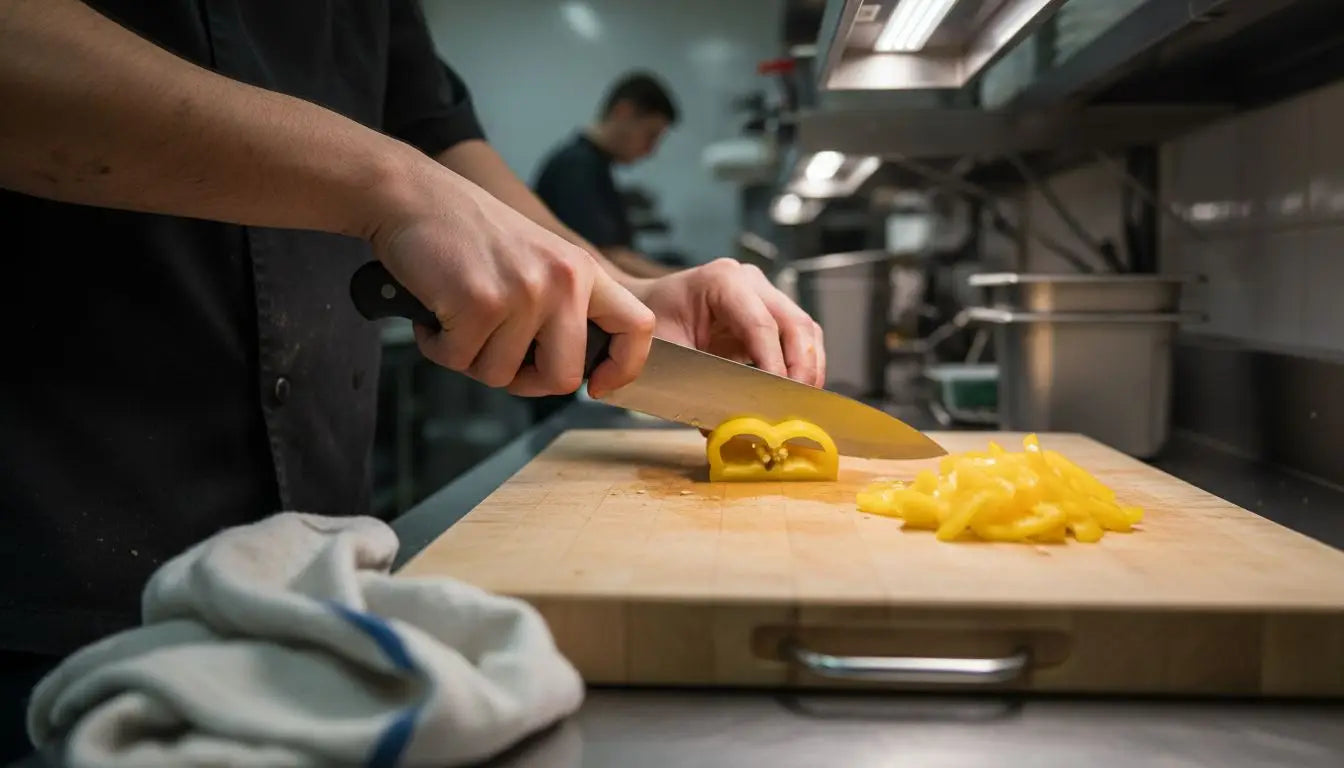
Step 4: Slice and chop with precision using proper motion
Mastering professional cutting techniques transforms your culinary skills from amateur to expert, turning each slice into a deliberate and precise movement. The way you move your knife determines the consistency, quality, and efficiency of your food preparation.
Professional cutting techniques involve several essential motion styles that professional chefs employ to maximize control and minimize effort. These techniques include:
- The rocking chop
- The push cut
- The cross chop
- The slice and glide
- The tap chop
Understanding the primary cutting motions requires practicing three fundamental techniques:
- Rocking Motion: Keep knife tip touching the cutting board
- Forward Slicing: Glide knife smoothly through ingredients
- Vertical Chopping: Use controlled up-and-down movements
Each motion serves a specific purpose. The rocking motion works best for herbs and soft vegetables, while forward slicing creates clean cuts through proteins and firmer produce. Blade angle and pressure play crucial roles in achieving consistent results.
Precision in motion transforms ordinary ingredients into culinary masterpieces.
Pro tip: Practice each cutting motion slowly and deliberately, focusing on maintaining a consistent angle and smooth movement before increasing your speed.
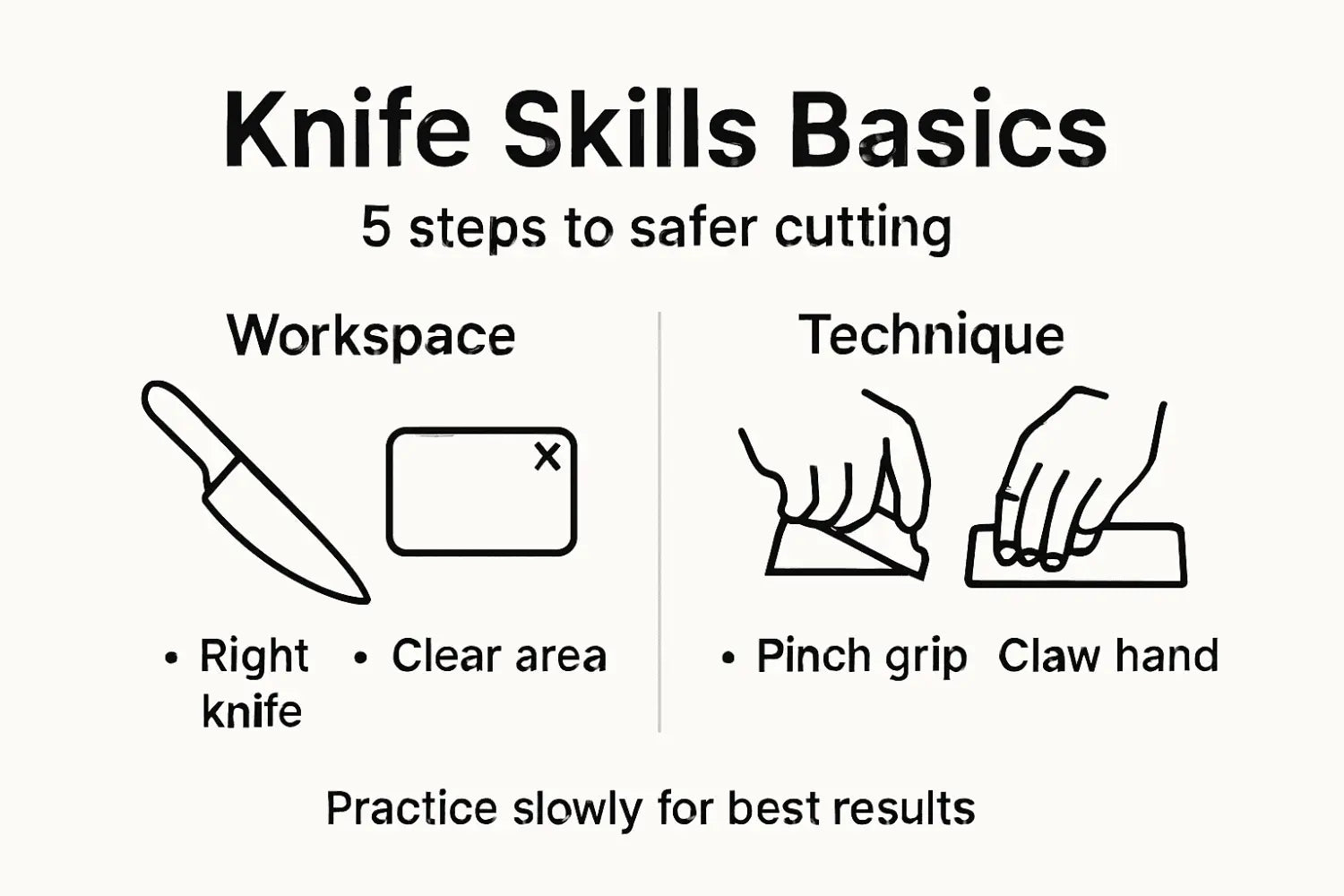
Step 5: Check and refine cutting consistency and technique
Mastering knife skills is a continuous journey of precision, self-observation, and deliberate practice. Every professional chef understands that cutting consistency is not just about technique, but about developing muscle memory and critical self-evaluation.
Professional cutting refinement requires systematic evaluation of your cutting performance. The key strategies for improving your technique include:
- Measuring slice uniformity
- Comparing cut sizes side by side
- Practicing repetitive motions
- Analyzing cooking and plating results
- Recording your progress
Developing precise cutting techniques involves multiple assessment methods:
To help you evaluate your knife skills, here’s a summary of key cutting consistency assessment methods:
| Assessment Method | What to Examine | Benefit |
|---|---|---|
| Visual Inspection | Uniformity of cut pieces | Ensures presentation quality |
| Weight Comparison | Similar weight of portions | Promotes even cooking |
| Cooking Performance | How pieces cook together | Confirms technique effectiveness |
| Photographic Tracking | Documenting progress visually | Tracks skill improvement |
- Visual Inspection: Lay out cuts to check uniformity
- Weight Comparison: Ensure similar piece sizes
- Cooking Performance: Evaluate how cuts cook evenly
- Photographic Tracking: Document improvement over time
The most critical aspect of refinement is maintaining consistent blade angle and steady hand movement. Use your knuckles as a consistent guide and pay attention to the pressure and speed of your cuts.
Perfection in cutting is not about speed, but about intentional, controlled movement.
Pro tip: Practice cutting identical ingredients multiple times, then measure and compare your results to track your improvement systematically.
Elevate Your Knife Skills with Premium Damascus Steel Knives
Mastering professional knife handling techniques requires not only skill and practice but also the right tools engineered for precision and control. The challenges of achieving a perfect pinch grip, maintaining consistent blade angle, and executing safe cuts become far easier when paired with expertly crafted cutlery. Your guiding hand deserves the support of a knife that feels perfectly balanced and comfortable in every move.
Discover the superior craftsmanship of our Damascus knives collection where cutting-edge artistry meets exceptional durability. Whether you need a versatile chef’s knife for rocking chops or a specialized utility blade to refine your slicing motions, Faneema Cutlery equips you with tools designed to elevate your culinary performance. Experience the unmatched sharpness and ergonomic design that transforms kitchen tasks into effortless, safe, and confident movements. Step into mastery today by exploring our full range at Faneema Cutlery and take advantage of premium knives that match your dedication to precision.
Complement your skills with expertly selected knives from our quality skinner knife collection to round out your culinary arsenal. Your journey toward professional-level cutting starts right here.
Frequently Asked Questions
What is the best way to set up my kitchen workspace for professional knife handling?
Setting up your kitchen workspace involves creating a functional work triangle between your stove, sink, and refrigerator. Designate specific zones for meat preparation, vegetable chopping, and baking to enhance efficiency. Prioritize organization to make cooking safer and more productive.
How do I choose the right knife for my culinary tasks?
Selecting the right knife depends on the size and type of food you will be preparing. For example, use a Chef’s Knife for versatile slicing and chopping and a Paring Knife for precise detail work. Assess your knife’s balance and comfort in your hand to ensure optimal performance.
Can you explain the proper knife grip technique for chefs?
The professional pinch grip is recommended for optimal knife control. Pinch the blade just in front of the bolster with your thumb and index finger, while wrapping the remaining fingers around the handle. This grips enhances precision and reduces wrist strain, making cutting safer and more efficient.
What is the claw grip and how should I use it for knife safety?
The claw grip is a hand positioning technique that protects your fingers while cutting. Curl your fingertips inward and use your knuckles as a guide, keeping your fingertips away from the knife blade. Practice this grip with soft vegetables to build muscle memory and enhance safety.
How can I improve my cutting consistency and technique?
Improving cutting consistency involves systematically evaluating your technique. Conduct visual inspections of your cuts for uniformity and compare weight to ensure even cooking. Regularly practice and document your progress to refine your knife skills over time.
What are some key cutting motions I should master as a chef?
Key cutting motions include the rocking chop, forward slicing, and vertical chopping. Each motion is suited for specific ingredients: use the rocking motion for herbs and the forward slicing technique for proteins. Practice these methods slowly to develop precision before increasing speed.
Recommended
- Choosing a selection results in a full page refresh.