

Role of Knife Sets in Cooking: Precision and Performance
Every seasoned chef and dedicated home cook knows the struggle of mismatched blades slowing down prep work and dulling creativity. A knife set serves as your culinary foundation, designed to tackle everything from precision peeling to hearty bread slicing. When you choose knives with the right balance of material quality and craftsmanship, your kitchen transforms into a space where efficiency and skill meet. Discover how the right Damascus knife set can elevate every cutting task, streamline your workflow, and bring joy back to your cooking routine.
Table of Contents
- Defining Knife Sets And Their Purpose
- Types Of Knives Included In Sets
- Material Quality And Craftsmanship Impact
- Practical Benefits For Everyday Cooking
- Common Mistakes And Proper Knife Care
Key Takeaways
| Point | Details |
|---|---|
| Invest in a Quality Knife Set | A well-curated knife set enhances efficiency and cooking outcomes by providing the right tool for each task. |
| Understand Your Cooking Needs | Before purchasing, analyze your cooking patterns to select a set that aligns with your actual usage and preferences. |
| Proper Knife Care is Essential | Regular maintenance, including proper washing and honing, prolongs the life and performance of your knives. |
| Prioritize Material Quality | Choosing high-quality materials like Damascus steel significantly impacts both the performance and longevity of your knife set. |
Defining Knife Sets and Their Purpose
A knife set is fundamentally a curated collection of specialized cutting tools designed to handle the diverse demands of food preparation. Unlike grabbing random knives from a drawer, a well-constructed set brings intentionality to your kitchen workflow. According to professional standards, knife sets refer to collections designed for various household and culinary tasks, serving as essential tools that enable both precision and performance in cutting operations. Think of a knife set as your culinary foundation, where each blade serves a specific function and together they create a cohesive system that amplifies your cooking capabilities.
When you invest in a quality knife set, you’re acquiring more than individual tools, you’re building a unified ecosystem for food preparation. A comprehensive set typically combines general-purpose blades like a chef’s knife, the workhorse of any kitchen, with specialized options such as paring knives for detailed work and bread knives for delicate slicing. Kitchen knife sets generally include general-purpose knives paired with specialized knives that fulfill distinct roles in food preparation. This combination matters because the right tool for each task doesn’t just improve efficiency, it transforms your entire approach to cooking. A chef’s knife handles 90% of your work, but without a properly sized utility knife for vegetable prep or a specialized bread knife for crusty loaves, you’re constantly compromising and working against the tool instead of with it.
The purpose of owning a dedicated knife set goes beyond convenience. Professional chefs understand that precision cutting directly affects cooking outcomes, from how quickly vegetables cook to how evenly flavors distribute throughout a dish. When you select knives designed as a unified system, rather than random individual pieces, you ensure consistency in blade geometry, handle ergonomics, and cutting performance. This harmonization means less fatigue during long cooking sessions and more reliable results across different cutting techniques. Understanding how to select the features you need in a quality knife set helps you identify which combination of knives actually matches your cooking style and preferences, rather than purchasing generic sets with unused blades gathering dust in your knife block.
Pro tip: Before purchasing a knife set, spend time understanding your actual cooking patterns, not what you think you should cook, then ensure the set includes the 3-4 blades you’ll genuinely use weekly while avoiding bulky sets with redundant tools.
Types of Knives Included in Sets
A well-rounded knife set doesn’t just throw random blades together, it strategically combines different styles to cover your actual cooking needs. Typical kitchen knife sets include various knives such as chef’s knives, paring knives, bread knives, boning knives, and utility knives, with each serving a specific purpose in your kitchen workflow. The chef’s knife stands as the cornerstone of any quality set, handling roughly 80% of your cutting tasks from mincing garlic to slicing chicken. This workhorse blade, typically eight inches long, features a curved edge that rocks against the cutting board, making it ideal for chopping, slicing, and dicing. Next comes the paring knife, a compact three-to-four-inch blade designed for precise, detailed work where your chef’s knife would be overkill. Use it for peeling vegetables, deveining shrimp, or any task requiring fine control and accuracy. The bread knife is your specialized tool with a serrated edge that grips crusty surfaces without crushing the soft interior, essential for slicing artisan loaves, tomatoes, and even frozen items without squishing them flat.
Beyond these foundational blades, quality sets often include additional specialized knives that expand your capabilities. The utility knife fills the gap between your chef’s knife and paring knife, typically six inches long and perfect for tasks that don’t quite justify your larger chef’s knife. A boning knife curves sharply and tapers to a fine point, making it invaluable for separating meat from bone with surgical precision. Some premium sets add a santoku knife, a Japanese-style alternative to the chef’s knife that excels at precise slicing with its straighter blade and thinner profile. Specialty options like cleavers for heavy chopping or fillet knives for delicate fish work might appear in comprehensive collections designed for serious home cooks or professionals.
The beauty of owning a matched set rather than collecting random knives is consistency and balance. When blades come from the same manufacturer and design philosophy, handle ergonomics align, blade geometry complements each other, and overall performance feels cohesive across your cutting tasks. You’re not constantly adjusting your technique based on how a different knife feels in your hand. Common knife sets feature several primary knives offering comprehensive tools for a wide array of cooking tasks, meaning you’re investing in a system rather than individual pieces. Understanding which knife types matter most for your personal cooking style helps you avoid overstuffed sets with blades you’ll never use while ensuring you have the right tool when you need it.
Here’s how major kitchen knife types differ in purpose and function:
| Knife Type | Typical Length | Main Function | Ideal For |
|---|---|---|---|
| Chef’s Knife | 8 inches | Versatile chopping, slicing | Vegetables, meats, herbs |
| Paring Knife | 3-4 inches | Precision and detail work | Peeling, trimming, small fruits |
| Bread Knife | 8-10 inches | Slicing with serrated edge | Bread, tomatoes, cakes |
| Utility Knife | 6 inches | Mid-sized cutting tasks | Sandwiches, cleaning produce |
| Boning Knife | 5-6 inches | Removing meat from bone | Filleting, meat preparation |
Pro tip: Start with a quality chef’s knife, paring knife, and bread knife as your foundation, then add specialized knives only when you consistently find yourself frustrated by missing tools during actual cooking.
Material Quality and Craftsmanship Impact
The steel you choose determines everything about how your knife performs and how long it stays sharp. Material quality and craftsmanship critically impact the performance and durability of knives in a set, with the choice between carbon steel and stainless steel representing one of the most fundamental decisions affecting your cutting experience. Carbon steel holds a sharper edge longer and easier to sharpen, but requires more maintenance because it corrodes and stains if exposed to moisture. Stainless steel resists corrosion and demands less fussing, but it never quite achieves the razor-sharp edge that carbon steel delivers, and it’s harder to resharpen when the edge does dull. Damascus steel, the material favored by serious culinary professionals, blends the best qualities of both by layering different steel types together, creating blades that stay sharp longer while maintaining reasonable corrosion resistance. The visual beauty of Damascus steel patterns reflects the quality forging process underneath, not just aesthetics.

What separates a mediocre knife set from a truly exceptional one comes down to how the steel gets treated and shaped. Craftsmanship influences knife quality significantly, with traditional methods such as repeated folding, layering, heating, and hammering of steel refining the blade’s strength and sharpness. When skilled blacksmiths hand-forge blades using these time-honored techniques, they’re not simply moving metal around, they’re aligning the steel’s crystalline structure and removing impurities that would otherwise weaken the blade. Proper heat treatment after forging determines whether your knife becomes brittle and prone to chipping or develops the ideal balance between hardness for cutting ability and toughness to prevent failure under stress. A knife that chips easily drives you crazy because every cutting session damages the blade. One that’s too soft gets dull after three meals. Understanding Damascus steel durability reveals how superior craftsmanship directly translates to blades that maintain sharpness longer and perform reliably through demanding kitchen tasks.
Investing in a quality knife set means paying for the expertise embedded in every blade. Mass produced sets use faster, cheaper manufacturing that skips steps where true craftsmanship happens. Hand-forged Damascus knives cost more upfront because skilled artisans spend hours perfecting each blade, testing hardness, adjusting heat treatment, and ensuring the edge geometry matches specifications. This initial investment pays dividends because your blades stay sharp longer, require less maintenance, and genuinely feel better in your hand during actual cooking. A poorly crafted knife frustrates you daily, dulls within weeks, and forces constant resharpening. A well crafted blade becomes an extension of your hand, making precise cuts with minimal effort. When you pick up a professionally crafted knife, the difference is immediately obvious from the balance and the way the edge bites into a tomato.
Below is a comparison of popular knife blade materials and their impact:
| Material | Edge Retention | Corrosion Resistance | Maintenance Level |
|---|---|---|---|
| Carbon Steel | Excellent sharpness | Low | Requires frequent drying |
| Stainless Steel | Good, less sharp | High | Minimal care needed |
| Damascus Steel | Superior balance | Moderate to High | Occasional oiling advised |
Pro tip: When evaluating knife quality, run your thumb lightly along the blade’s spine and handle transition, feel for rough spots or inconsistencies that signal poor craftsmanship, then test the edge on paper, a tomato, and a carrot to assess sharpness across different cutting scenarios.
Practical Benefits for Everyday Cooking
The difference between cooking with a quality knife set and throwing together random blades becomes obvious the moment you start your meal preparation. Knife sets provide practical benefits in everyday cooking by enabling efficient and precise cutting, which facilitates faster meal preparation, consistent food sizes for even cooking, and safer handling with proper technique. When your chef’s knife glides through an onion in smooth, controlled strokes rather than requiring aggressive sawing motions, you’re not just cutting faster, you’re reducing repetitive strain on your wrists and shoulders. That matters when you’re cooking dinner after a long workday. Consistent vegetable sizes mean your ingredients cook evenly, so your roasted vegetables don’t have some pieces burnt while others are still raw. Your sauce reduces uniformly, your protein cooks through without drying out. These aren’t minor conveniences, they’re the difference between meals that taste intentional and meals that taste like you were just trying to survive the process.
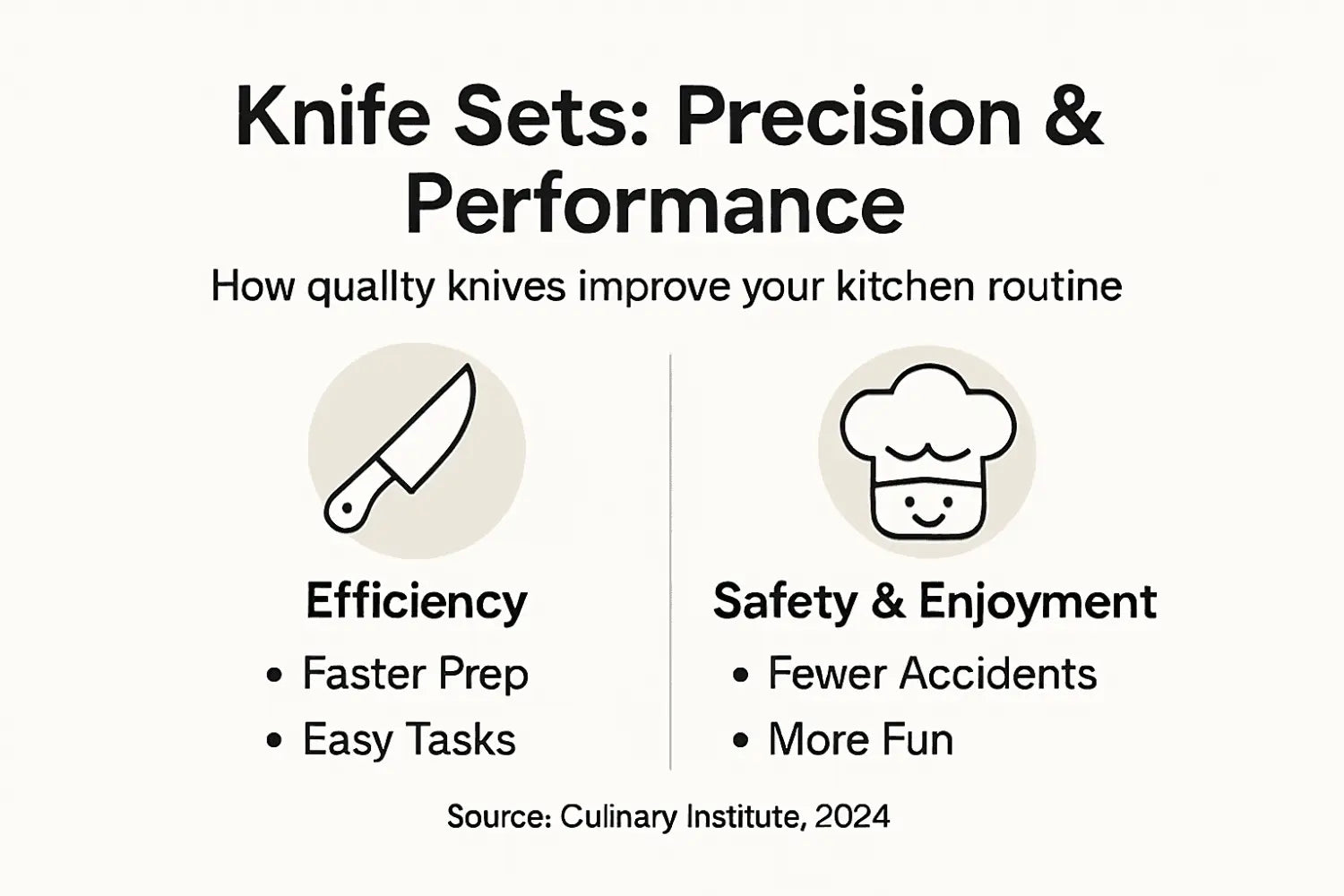
Safety improves dramatically when you have the right tool for each task. A dull knife that slips off a carrot and slides toward your fingers is far more dangerous than a sharp blade that bites cleanly into the cutting board. A properly balanced paring knife gives you the control needed to trim delicate herbs without crushing them or accidentally stabbing your palm. A serrated bread knife prevents the frustrating crush that happens when you try to slice a crusty loaf with a chef’s knife, eliminating the need for aggressive pressure that causes knife slips. Quality knives in a set maintain sharpness longer, which is critical for performance, precision, and safety, which means you’re not constantly fighting dull edges that demand extra force and attention. Cooking becomes more enjoyable when you’re confident in your tools rather than anxious about whether your knife will do what you’re asking.
Beyond efficiency and safety, a quality knife set transforms your relationship with cooking itself. Prepping vegetables becomes satisfying rather than tedious when your knife responds exactly how you expect it to. You develop better technique naturally because the knife does what you intend instead of fighting you. Home cooks who invest in proper knife sets report cooking more frequently and trying more ambitious recipes because the barrier to meal preparation drops significantly. You actually want to slice vegetables thin for a stir-fry instead of avoiding recipes that require that technique. You attempt homemade bread because slicing it properly is no longer a battle. Why invest in knife sets reveals how this confidence translates to spending more time in the kitchen doing something you enjoy rather than something you endure.
Pro tip: After each cooking session, immediately wash and dry your knives by hand rather than throwing them in the dishwasher, then store them in a knife block or on a magnetic strip so blades stay sharp and you always grab the right tool without searching through drawers.
Common Mistakes and Proper Knife Care
Most home cooks unknowingly sabotage their knife sets through well-intentioned but damaging practices. The dishwasher, that miraculous time-saving machine, is your knife’s worst enemy. High heat, harsh detergents, and banging against other dishes dull blades faster than almost anything else and can crack handles. Common mistakes with knife use include improper grip, cutting technique, lack of sharpening, and unsafe storage. Your beautiful Damascus steel knife set deserves hand washing with warm soapy water and immediate drying, not a spin cycle. Loose storage in drawers where blades clang against each other constantly damages edges far more than you realize. Storing knives properly in a knife block or on a magnetic strip protects both the blade and your fingers when reaching into a drawer. Cutting on hard surfaces like glass or marble countertops also chips blades, so always use wood or plastic cutting boards that give slightly when the knife lands.
Sharpening and honing confusion creates another widespread problem. These aren’t the same thing, and using them correctly extends your blade’s life dramatically. Honing realigns the blade’s edge without removing steel, something you should do weekly or even between uses on a steel or ceramic honing rod. It takes thirty seconds and keeps your knife working at peak performance. Sharpening actually removes steel to create a new edge when your blade gets truly dull, something you do only a few times yearly if you hone regularly. Using a dull knife forces you to apply pressure that leads to slips, accidents, and frustration. Proper knife care involves regularly honing and sharpening the blade, hand washing and drying knives promptly, storing them safely in knife blocks or magnetic strips, and using the appropriate cutting surfaces to preserve sharpness and extend knife life. Many home cooks never sharpen their knives and wonder why cooking feels exhausting.
Incorrect cutting technique damages both you and your blades. Chopping motion that comes down hard on the board forces the blade sideways slightly, putting stress on the edge. The proper rocking motion, keeping the knife tip on the board and using a gentle forward and backward motion instead, preserves your blade while actually being faster and less tiring. Knife care includes keeping knives sharp and clean, handling them carefully to avoid accidents, and using the right knife for each task. Cutting towards yourself rather than away is an accident waiting to happen, and your knife isn’t responsible for your safety if you ignore basic handling principles. Understanding the top techniques for maintaining your Damascus knives reveals how small daily habits compound into either years of reliable performance or quick deterioration.
Pro tip: Invest in a simple ceramic honing steel and use it for thirty seconds before cooking, then have your knives professionally sharpened once yearly, this routine costs almost nothing but transforms how your blades perform compared to the endless frustration of working with dull edges.
Elevate Your Cooking Experience with Precision Damascus Knife Sets
If you understand the importance of precision and performance in your kitchen tools you know how crucial the right knife set is for consistent results and effortless cutting. The challenge many home cooks face is finding a set that balances sharpness durability and ergonomic design while avoiding unnecessary blades that add clutter. Faneema Cutlery specializes in premium handcrafted Damascus steel knives that deliver exactly that balance through expert craftsmanship and superior materials. Their carefully curated premium chef knife sets optimize your kitchen workflow by including essential blades that meet your actual cooking needs.

Experience the difference a unified Damascus knife collection makes in your daily cooking while enjoying sharper longer-lasting edges and handles designed for comfort. Don’t settle for generic sets full of redundant pieces that frustrate more than help. Visit Faneema Cutlery now and explore their range including versatile Damascus paring knives perfect for detailed work. Upgrade your cooking tools today to reduce fatigue improve safety and increase confidence in every cut.
Frequently Asked Questions
What is the purpose of a knife set in cooking?
A knife set is designed to provide a curated collection of specialized cutting tools that enhance efficiency, precision, and performance during food preparation, allowing cooks to tackle various tasks with ease and consistency.
What types of knives are typically included in a knife set?
A typical knife set usually includes a chef’s knife, paring knife, bread knife, utility knife, and sometimes a boning knife or santoku knife, each serving specific purposes to cover diverse cooking tasks.
How does the quality of materials affect the performance of a knife set?
The quality of materials, such as carbon steel, stainless steel, or Damascus steel, significantly impacts a knife’s edge retention, corrosion resistance, and overall durability, influencing how well the knife performs and how long it stays sharp.
Why is proper knife care important for maintaining a knife set?
Proper knife care, including regular honing, washing by hand, safe storage, and using the correct cutting surfaces, helps maintain sharpness, prevents damage, and extends the lifespan of the blades, ensuring reliable performance in the kitchen.
Recommended
- Choosing a selection results in a full page refresh.