

Safe Knife Handling Guide for Damascus Steel Chefs
A flawless dish often starts long before the first slice ever touches the board. Whether you are a seasoned chef working in a vibrant New York kitchen or a passionate home cook in California, mastering the art of safe knife handling with a Damascus steel blade sets the standard for both confidence and precision in your craft. This guide reveals how preparing your workspace, tools, and ingredients can help you work safely, protect your culinary investments, and keep every cut under control.
Table of Contents
- Step 1: Prepare Your Workspace And Tools
- Step 2: Inspect And Grip Your Damascus Steel Knife
- Step 3: Position Your Ingredients Securely
- Step 4: Execute Safe Cutting Motions Correctly
- Step 5: Store And Maintain Your Knives Safely
Quick Summary
| Key Point | Explanation |
|---|---|
| 1. Clear Your Workspace | Remove unnecessary items from your cutting surface to prevent accidents and allow for free movement while cutting. |
| 2. Inspect Your Knife | Check your Damascus steel knife for damage and ensure it is clean and sharp for safe, effective cutting. |
| 3. Proper Ingredient Positioning | Stabilize ingredients by placing flat sides down to prevent rolling and facilitate safer cutting motions. |
| 4. Use Correct Cutting Techniques | Keep the knife tip on the board as a pivot, using your knuckles as a guide to maintain control and safety while cutting. |
| 5. Store Knives Correctly | Use appropriate storage methods and regular maintenance to preserve your knife’s sharpness and safety, ensuring longevity. |
Step 1: Prepare your workspace and tools
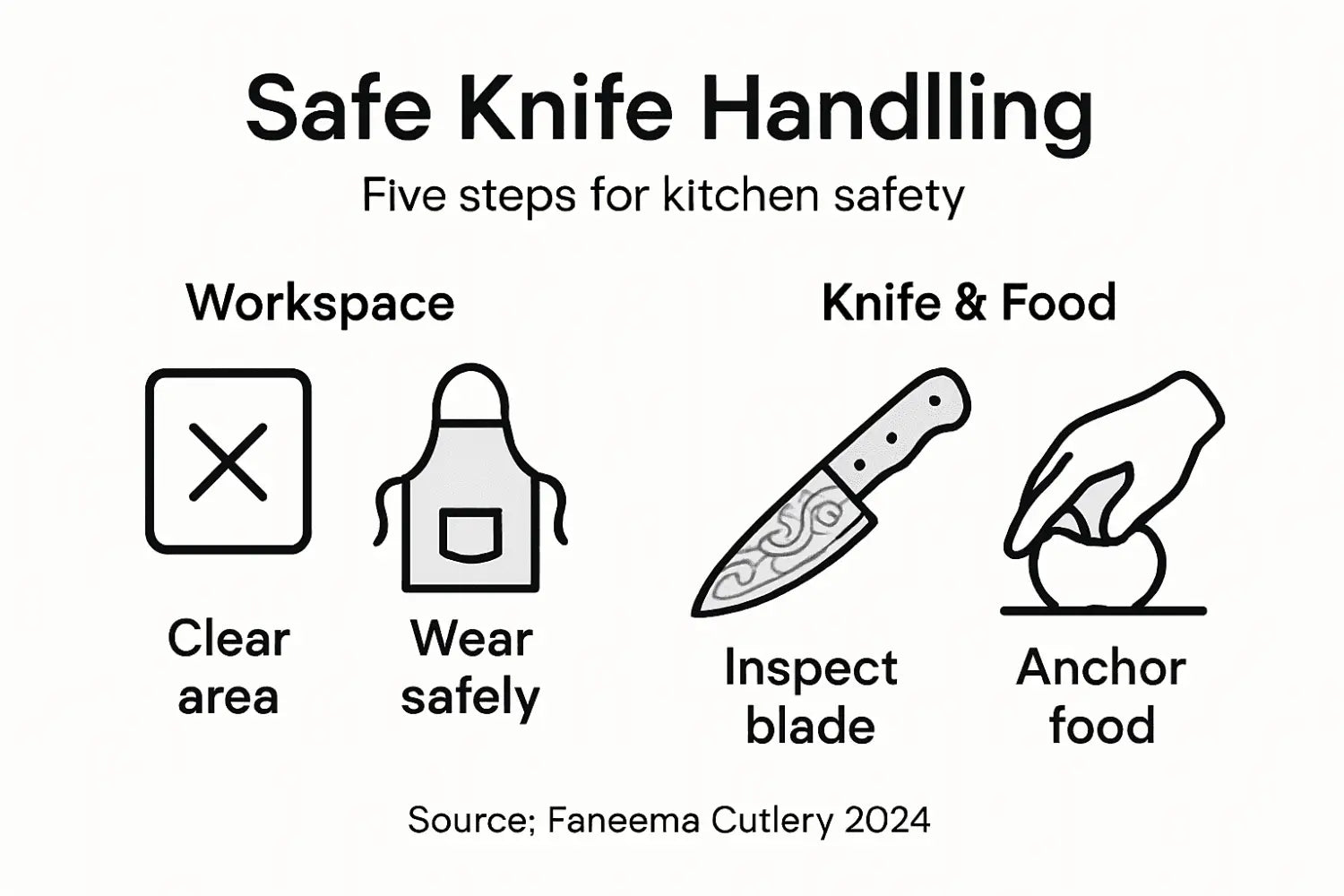
Before you touch your Damascus steel knife, your workspace needs to be ready. This step prevents accidents, protects your knife’s edge, and sets you up for confident, controlled cutting. A well-prepared environment is the foundation of safe knife handling, so take the time to get this right.
Start by clearing your cutting surface and surrounding area of anything unnecessary. Remove bottles, utensils, papers, or anything else that doesn’t belong on your counter. Your hands and the knife need room to move freely without obstacles. Next, inspect the actual cutting board itself. A warped or damaged board creates an uneven surface that causes the knife to catch or slip unexpectedly. If you’re using a plastic board, check for cracks or gouges that could trap moisture or harbor bacteria. For wooden boards, ensure they’re flat and securely placed on your counter. Most importantly, wipe your cutting surface clean and dry. A wet or greasy board turns into a skating rink for your knife, and that’s when accidents happen.
Now turn your attention to your Damascus steel knife. Inspect tools for damage before use by running your eyes and fingers along the entire blade, handle, and hilt. Look for nicks, cracks, or any deformities in the blade. Check the handle for loose rivets or splintering wood. A blade with damage won’t cut predictably and becomes genuinely dangerous. Make sure your knife is clean and dry. Any residue or moisture reduces your grip and control. Test the sharpness carefully by gently pressing the blade perpendicular to your thumbnail with minimal pressure. A properly sharp knife requires less force, which means less fatigue and fewer mistakes during extended use. As you prepare, also ensure you have proper lighting. You need to see exactly what you’re doing, including where your fingers are in relation to the blade. Good visibility prevents careless injuries that happen in dim lighting.
Consider what you’re wearing as well. Avoid loose, dangling sleeves or jewelry that could catch on your knife. Keep your hands completely dry and clean before beginning any cutting tasks. Some chefs prefer using a damp towel nearby to occasionally wipe their hands if they become wet during food prep. This small step keeps your grip secure throughout your work session.
Here’s a summary of workspace preparation factors for safe knife handling:
| Factor | Why It Matters | Best Practice |
|---|---|---|
| Cutting Surface | Avoids slips, uneven cuts | Clean, dry, stable board |
| Knife Condition | Prevents unpredictable cuts | Inspect for damage, sharpness |
| Lighting | Reduces injury risk | Use bright, direct workspace light |
| Clothing | Prevents snagging accidents | Secure sleeves, remove jewelry |
| Hand Hygiene | Maintains grip and control | Dry, clean hands before cutting |
Pro tip: Create a dedicated cutting station with your knife, board, and necessary prep bowls already positioned before you start cooking, so you’re never fumbling to find equipment while holding a sharp blade.
Step 2: Inspect and grip your Damascus steel knife
Now that your workspace is ready, you need to properly inspect your Damascus steel knife and establish a grip that gives you full control. This step determines whether you’ll handle the knife confidently or struggle with slipping and awkward angles. Getting the inspection and grip right takes just a few minutes but prevents most cutting accidents before they happen.
Begin your inspection by holding the knife under good light and examining the blade carefully. Look at the Damascus pattern along the blade’s surface. This layered steel should show consistent waves and lines without any sudden breaks or irregular spots. Run your finger gently along the spine of the blade, checking for any chips or cracks that would compromise its structural integrity. Pay special attention to the edge itself. A proper Damascus blade should feel consistently sharp along its entire length, not dull in some spots and sharp in others. Check the handle by gripping it firmly and looking for any movement or flex. The handle should feel solid and not wobble on the blade’s tang. Inspect where the blade meets the handle for any gaps or separation. Proper grip and tool control are critical for preventing accidents during use. If you notice any damage during inspection, set that knife aside and use a different one.
Once your blade passes inspection, focus on establishing your grip. Wrap your fingers around the handle with your thumb and index finger positioned just above the blade’s guard or bolster. Your remaining three fingers should wrap securely underneath the handle, creating a firm but not strangling grip. The knife should feel like an extension of your hand, not something you’re wrestling to control. Your wrist should remain straight and neutral, avoiding awkward postures that tire your arm and reduce precision. Many chefs find that a slightly elevated grip with your hand positioned higher on the handle gives better leverage and control than gripping at the very bottom. Test your grip by lifting the knife and simulating a cutting motion. It should move fluidly without requiring excessive muscular tension. If your forearm feels strained, adjust your hand position or check that you’re not tensing your shoulders.

Pro tip: Keep your grip consistent throughout your cutting session by checking your hand position every few minutes, as fatigue naturally causes your hand to migrate down the handle and weaken your control.
Step 3: Position your ingredients securely
How you position your ingredients on the cutting board directly affects your safety and cutting precision. An ingredient that moves or rolls unexpectedly forces you to make sudden adjustments with the knife, and those split-second reactions cause accidents. Taking a moment to stabilize your food before you start cutting eliminates this hazard entirely.
Start by choosing the right cutting board for each ingredient type. If you are working with proteins like chicken or fish, use a dedicated board to prevent cross contamination. Once you have selected your board, place your ingredient in a stable position. Round items like onions, peppers, or potatoes are the biggest culprits for rolling or shifting. The solution is simple: cut them in half first to create a flat surface. That flat side becomes your stable base. Place the flat side down on your board, and the ingredient becomes anchored in place. For something like an onion, this one cut transforms it from a rolling hazard into a fixed target. Your knife will meet consistent resistance as you cut, and your hand stays exactly where you expect it to be. Long vegetables like carrots or zucchini naturally want to roll sideways. Stabilize them by applying gentle, consistent downward pressure with your non-knife hand, or use a claw grip to hold them steady. Securing ingredients on stable surfaces prevents the movement that leads to slips and dangerous contact with the blade.
As you cut, keep checking that your ingredient hasn’t shifted position. After every few cuts, pause and verify that the food is still sitting flat on your board exactly where you want it. If you notice it moving, reposition it before continuing. This habit takes only seconds but prevents the surprise shifts that catch your knife hand off guard. For items with skins or waxy surfaces like potatoes or apples, consider placing a damp paper towel underneath the cutting board itself. This prevents the entire board from sliding across your counter, which can destabilize both your ingredients and your stance. The goal is complete stillness. Your knife should move with intention and control, meeting zero resistance from unstable food.
Pro tip: Always position round or oblong ingredients with their flattest side down, and mentally commit to making that first stabilizing cut even if the recipe doesn’t strictly require it, since the safety gain justifies the extra thirty seconds.
Step 4: Execute safe cutting motions correctly
Your cutting technique determines everything. A proper cutting motion generates power and control while keeping your hands protected. A sloppy technique fights against the knife’s natural design and puts your fingers directly in harm’s way. This is where Damascus steel knives truly shine, as their superior sharpness rewards proper technique and punishes poor form immediately.
Start with the foundation of safe cutting. Position your knife so the tip stays in contact with the cutting board throughout the entire motion. This tip on the board acts as a pivot point and anchor, preventing wild, uncontrolled movements. Rock the blade forward and backward using this pivot, allowing the knife’s edge to do the work rather than forcing the blade through the ingredient with brute force. Your Damascus blade is sharp enough to slice cleanly with minimal pressure, so let the steel work for you. The moment you feel yourself pushing hard, you have already lost control. Now focus on your guide hand, the one holding the ingredient. Curl your fingers inward, making a loose fist with your knuckles facing forward. Your knuckles become the guide that the blade rides against, not your fingertips. This positioning is non-negotiable. Keeping fingers curled and using knuckles as guides protects your fingertips while providing a consistent surface for the blade to follow.
As you cut, always move the blade away from your body. Never pull the knife toward yourself or cut at awkward angles where the blade path crosses your arms or torso. If the blade slips, you want it moving away from you, not into you. Keep your shoulders relaxed and your cutting motions smooth and deliberate. Avoid sudden jerks or speed bursts that sacrifice control for velocity. Your Damascus knife will produce consistent results at a steady, controlled pace. Between cuts, maintain awareness of your blade’s position and your hand placement. Never look away from your work or let your attention drift. The moment you stop paying attention is when accidents happen. Practice these motions on easy items first, like soft vegetables, before moving to harder ingredients that require more force. Your muscle memory will develop quickly if you practice correctly from the start.
Pro tip: Practice your rocking motion on a cutting board without food first, focusing entirely on keeping your tip anchored and your guide hand knuckles steady, until the movement becomes automatic and requires zero conscious thought.
Step 5: Store and maintain your knives safely
What happens after you finish cutting matters just as much as your technique during cutting. How you store and maintain your Damascus steel knives determines whether they remain razor sharp and safe for years or gradually deteriorate into dangerous, unpredictable tools. The good news is that proper storage and maintenance require minimal effort once you establish the right habits.
Start with storage immediately after you finish cooking. Never leave your knife sitting on the counter or tossed into a crowded utensil drawer where blades rub against other metal tools. This destroys the edge and creates safety hazards for anyone reaching into that drawer. Instead, store your knife in a wooden knife block that has designated slots, a magnetic strip mounted on your wall, or a protective sheath that covers the entire blade. Each of these options keeps the blade protected from damage and prevents accidental contact with the sharp edge. If you use a knife block, make sure the slots are clean and dry before sliding the blade in. Moisture trapped in a slot can promote corrosion on your Damascus steel. After every use, hand wash your knife with warm soapy water and dry it immediately with a soft cloth. Never put Damascus steel knives in the dishwasher, as the harsh environment damages the blade and can cause the handle to crack or warp. Dry the blade completely, paying special attention to the spine and the area where the blade meets the handle, where moisture likes to hide.
Maintenance goes beyond cleaning. Your Damascus blade needs regular honing to maintain its edge alignment and periodic sharpening to restore the cutting surface. Regular honing and sharpening maintain blade performance and keep your knife functioning safely and efficiently. Honing takes 30 seconds and should happen every few uses, while sharpening is a deeper process that happens every few months depending on how frequently you cook. A dull blade is genuinely dangerous because it requires more pressure to cut, increasing the chance of slipping. Test your blade’s sharpness monthly by attempting to slice a ripe tomato with minimal pressure. If the knife crushes the tomato instead of cleanly slicing through it, the blade needs sharpening. Store your knives in a cool, dry location away from extreme temperature changes that can warp the handle or affect the steel’s temper. Keep them separate from acidic ingredients or marinades that can splash onto the blade during storage. Your Damascus knives are investments in your cooking, and they will perform beautifully for decades if you treat them with respect.
Compare storage and maintenance strategies for Damascus steel knives:
| Method | Blade Protection | Long-Term Benefits |
|---|---|---|
| Wooden Block | Prevents edge contact | Preserves sharpness, safety |
| Magnetic Strip | Easy visual checks | Minimizes accidental damage |
| Blade Sheath | Shields whole blade | Ideal for drawer storage |
| Regular Honing | Maintains cutting edge | Reduces major sharpening |
| Proper Cleaning | Prevents corrosion, wear | Extends knife lifespan |
Pro tip: Establish a weekly maintenance routine where you hone your blade on a honing steel and inspect the edge and handle for any signs of damage, taking just five minutes to prevent major problems from developing.
Elevate Your Cutting Experience with Precision Damascus Steel Knives
Mastering safe knife handling is essential for protecting your hands and enhancing your culinary skills. The challenges of maintaining control, positioning ingredients securely, and executing smooth cutting motions demand tools that perform without compromise. When your knife offers unmatched sharpness and reliability, like our artisan-crafted Damascus steel knives, you gain the confidence to cut precisely and safely every time.
Discover the superior craftsmanship behind our collection of Damascus knives for precise cutting that blend beauty and performance. With blades designed for balance, durability, and razor-sharp edges, these knives help you maintain a safe grip and reduce fatigue during food prep.

Take control of your culinary journey today. Explore the full range of expertly forged knives at Faneema Cutlery and invest in tools built to last. From professional chefs to home cooks passionate about quality, these knives are crafted to elevate your cutting technique and keep safety front and center. Visit our quality skinning knives collection to find specialized blades that meet your specific needs. Shop now and experience the difference of premium Damascus steel craftsmanship.
Frequently Asked Questions
How do I prepare my workspace for safe knife handling with a Damascus steel knife?
To prepare your workspace, begin by clearing everything unnecessary from your cutting surface and ensuring it is clean and dry. Inspect your cutting board for damage and ensure that your Damascus steel knife is also in good condition before starting your preparation.
What should I check during the inspection of my Damascus steel knife?
When inspecting your Damascus steel knife, check for any nicks, cracks, or deformities along the blade and ensure the handle is securely attached. Make sure that the knife is clean, dry, and sharp, and test the sharpness by gently pressing it against your thumbnail with minimal pressure.
What is the best way to grip my Damascus steel knife for optimal control?
Grip your Damascus steel knife by wrapping your fingers around the handle, with your thumb and index finger just above the blade’s guard. Your remaining fingers should wrap under the handle, ensuring a firm but comfortable grip that allows for smooth and controlled cutting motions.
How can I ensure the ingredients are securely positioned while cutting?
Stabilize your ingredients by placing them flat on the cutting board; for round items, cut them in half to create a stable base. Always check the position of your ingredients after every few cuts to ensure they remain fixed and secure during the chopping process.
What are the proper cutting techniques to use with a Damascus steel knife?
Use a rocking motion while keeping the tip of the knife on the cutting board as a pivot point. Avoid sudden jerks by maintaining a steady, even pace, and always position your guide hand with curled fingers to protect your fingertips while allowing the knife to move freely over your knuckles.
What maintenance practices should I follow for my Damascus steel knives?
To maintain your Damascus steel knives, store them properly in a wooden block or magnetic strip and hand wash them after use. Hone the blade every few uses and sharpen it every month; a dull blade increases the risk of accidents, so keep your knife in top condition for safe and effective cooking.
Recommended
- Choosing a selection results in a full page refresh.